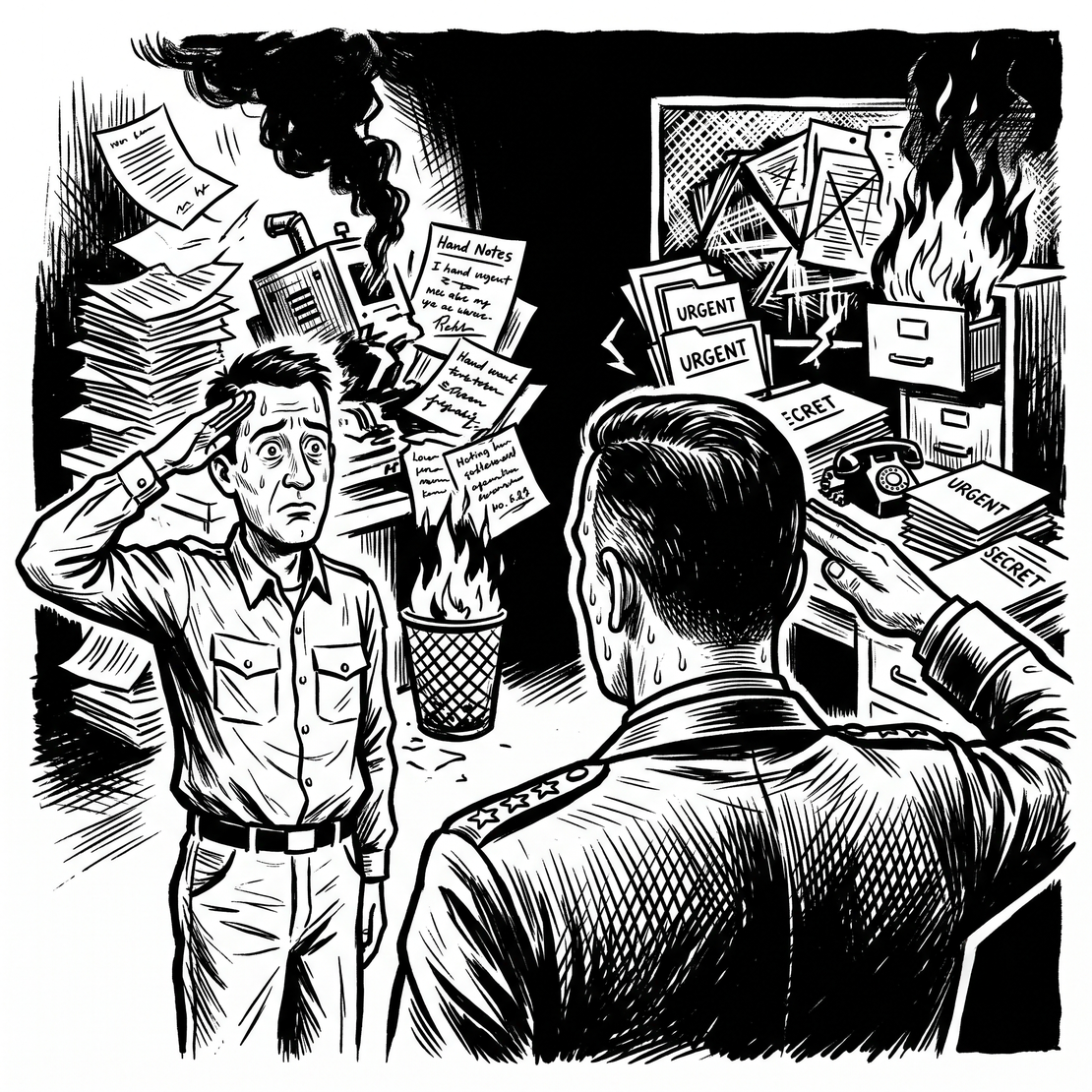
If everyone around keeps saying yes, you have a problem.
It’s odd, yet most leaders fail to think about it: Everyone is busy, but pushback is rare.
We live in a Culture of Busyness, as the HBR has named it. We all are running around, but are we really focusing on our highest value activities? Is being active the same as making progress?
Over-delegation occurs when you have lived it yourself. Your mind is capable of juggling dozens of problems at the same time, and because you have others to work with, now you juggle hundreds. We delegate what we can and must, but then advise others to do the same. Join me, my fellow leaders, into keeping everybody busy!. Interestingly, people can feel more agency standing up in the train when commuting, than when sitting in front of their monitor.
Over-delegation is a consequence that has its own consequences.
Compounding the anti-pattern
What happens when you over-delegate? You might be thinking that the main consequence is that you are overloading someone else, and/or that someone else will overload someone who reports to them. Right?
Well, that is the short term. That is the immediate consequence.
“Can you handle it?”
You ask if they can handle it, and they say “oh yes, of course”… I have fallen for this many times.
How we say something does impact the answer, even if it is the same question. When people say Yes they do not necessarily mean it, and I bet you have done the same in the past.
What we are asking about is workload, capacity, time. But what they are hearing is a challenge to their competence, intelligence, skills. Even if the real answer were “no”, you might still get a “oh yes, of course”. The fear of rejection is so real that it makes people around you not reject you instead, as if it were some kind of human feedback loop.
This is the wrong question to ask. But, on top of this, the long term consequence created here is that there is an unsafe environment to speak up. This could be primarily a perceived reality only, although I have seen many leaders believe they have created a safe environment, but immediately change their demeanor, their tone of voice and their stance when they get pushed back.
Where do we go from here? A better, yet not perfect, question for all of this could be:
Do you have the time?
Capacity is, after all, a very common topic nowadays. And why wouldn’t it be, if we are in a culture of busyness?
This question is a bit more direct. You are specifically asking about their schedule, or trying to. However, this is still an inadequate way of interacting with someone who reports to you. The other party is likely to still say “oh yes, of course”. You could take notice of how quickly they reply and then suspect something is up, but in this situation where you are highly pressured, you will probably not see it, and continue delegating. And delegate more, and more.
So, here is a much better question:
If we prioritise this now, what should we consider leaving out?
You might be thinking that you, the leader, must be crystal clear and establish all priorities beforehand with absolute precision. Well, you do, but hear me out. Here we are framing the question in a way that makes the other party specifically think about what else is going on, and what can be moved out. It invites an analysis of balance. As a matter of fact, that is what you asked for. Many times, they will say I think we can squeeze this in anyway or something similar. Sometimes they will say You tell me and that’s perfectly fine. The direct report has rejected your question, but more importantly they do not feel empowered to answer or make any decisions. This is important knowledge for you as a leader.
“The test of happiness is the amount of control you have over your time.”
— Nassim Nicholas Taleb, The Black Swan: The Impact of the Highly Improbable, 2007
We improved our questions, our language, so that we can foster autonomy and invite the direct report to take control. We are not there yet. However, at this point, we have established the complexities of verbal communication and the intricacies of how our brains actually operate. The short term consequence is overloading someone, but the long term consequence is creating a system destined to manufacture systemic frustration, not new leaders.
Of Space and Void
Mindlessly delegating down to our people will reinforce this and eventually create a snowball that cannot be stopped. So what do we do?
Our job as leaders is to watch over the space of our people. What do I mean by that? Well, let’s put it in simple performance terms.
People, teams, organisations, exist in relation to the space they are in. We can see this from all perspectives: Industries, competitors, social networks, acquaintances, and other teams. As we watch over the space, the way you do that is by having real empathy. And to do that we must see past the employee, past the payroll, and see the human being they are, and the one we are. Even when divided by a screen, we are sharing a moment in the same space, and we are part of them as much as they are part of us, as with anything that surrounds us.
“Certainly the world of nature abounds with surfaces and lines, with areas of density and vacuity, which we employ in making out the boundaries of events and things. But here again, the maya doctrine asserts that these forms have no “own-being” or “self-nature”: they do not exist in their own right, but only in relation to a space…”
— The Way of Zen, Alan Watts, 2024 (recollections)
If you are struggling to care or you are thinking about how to care, then you really do not care. The same way that thinking about an activity is not doing it, and talking about work is not working.
We have the responsibility to drive our teams in a profitable and sustainable manner. And while that might sound obvious, we must also observe that nowadays we have an epidemic of “busyness culture”, of “performative culture”, of only focusing on the delivery and not on the system that creates said delivery. Everything must be spinning and any space for nothing is a mistake to be eradicated. However, thought is expected and “verbally encouraged”, but if we as leaders do not follow up with action to create space, then none is given.
Organisations that are affected by this epidemic prioritise and optimise for “fast” decisions, and get nervous at the very idea of employees being “slightly misaligned” or not “actively engaged”. Ill-conceived direction is preferred over well-thought visions.
The Cost of Unclarity
Direction flows into your organisation like water flows down the mountain. But for that water to be clean and transparent, it gets filtered by the characteristics of the mountain itself. If that mountain is made of mud, you get muddy water.
In this scenario, the stress on leaders naturally increases, as they must become mountains themselves. Just as high pressure can compress carbon into diamonds, leaders can use this opportunity to strengthen themselves. When life forces resilience upon you, you are getting the experience that sets you apart from other leaders.
But even if you can withstand the pressure, and water flows from you without corroding your mind, you also have the utmost responsibility of filtering that stream so it comes out transparent from the other side. If what comes out of the bottom is muddy, it creates a compounding effect on any valleys below us. However, this does not mean you must withstand the “bullshit”, but that you must create weather of your own.
One indicator of sophistication at the leadership level in any organisation of any size is the attention and genuine interest of leaders to understand how their employees are experiencing life at their company. After all, we do spend a good amount of our life working. It is also simple to justify from the company’s point of view. Low employee engagement costs the global economy 9.6 trillion dollars in lost productivity annually.
“When organizations invest in their employees’ experience and engagement at work, they see 4x higher profitability… leaders were better at providing feedback than ever before – and this is helping drive higher employee performance”
— McLean & Company, 2026
Now more than ever, a leader’s job is to create the void, the emptiness that allows for a different kind of material to flow. And we see this has both humane and economic reasons.
Most burnout comes from the fact that people feel they have no control over their time. One of the main objectives of any leader must be to watch over their employees’ autonomy. And one of the best (and hardest) things you could do is to coach them into managing their own workload.
Let me be clear on this, your job is to create leverage, and for that you need transparency, clarity. And they need the space to observe it and absorb it.
It is similar to sitting outside in your garden, in a park or in some place of nature. If you remain silent, nature speaks back. But if you constantly talk, nature is muted. Space is attention, and attention allows us to control our experience naturally. If I am listening to the sounds of nature, I am silent yet fully embedded into the experience, and as I let it traverse my five senses, I am in control of my own agency and mind.
Creative thinking is applied on every single job regardless of how mechanical the tasks can be. And creativity requires space. If the weather pours a lack of clarity down onto the mountain, and leaders pass that confusion down, it creates a true compounding effect for the worse. This fosters lack of focus and confusion, driving poor profitability. These losses are rather difficult to detect, and if your company is already running in circles with an unclear execution mandate, then measuring confusion is probably not in your agenda anyway.
That’s where you come in.
- Your leaders are running in circles? Find an anchor.
- The vision is unclear? Build short term clarity for your team as you work on the long term.
- You want your team to succeed? Give them space.
- You want your direct reports to take back control? Ask better questions.
But most importantly, you must care. Stop thinking about it.
