When a conversation gets stuck, it is easy to reach for the same move every time: explain, decide, ask more questions or step away. Any of those can help. Any of them can also make things worse if it is the wrong response for that moment.
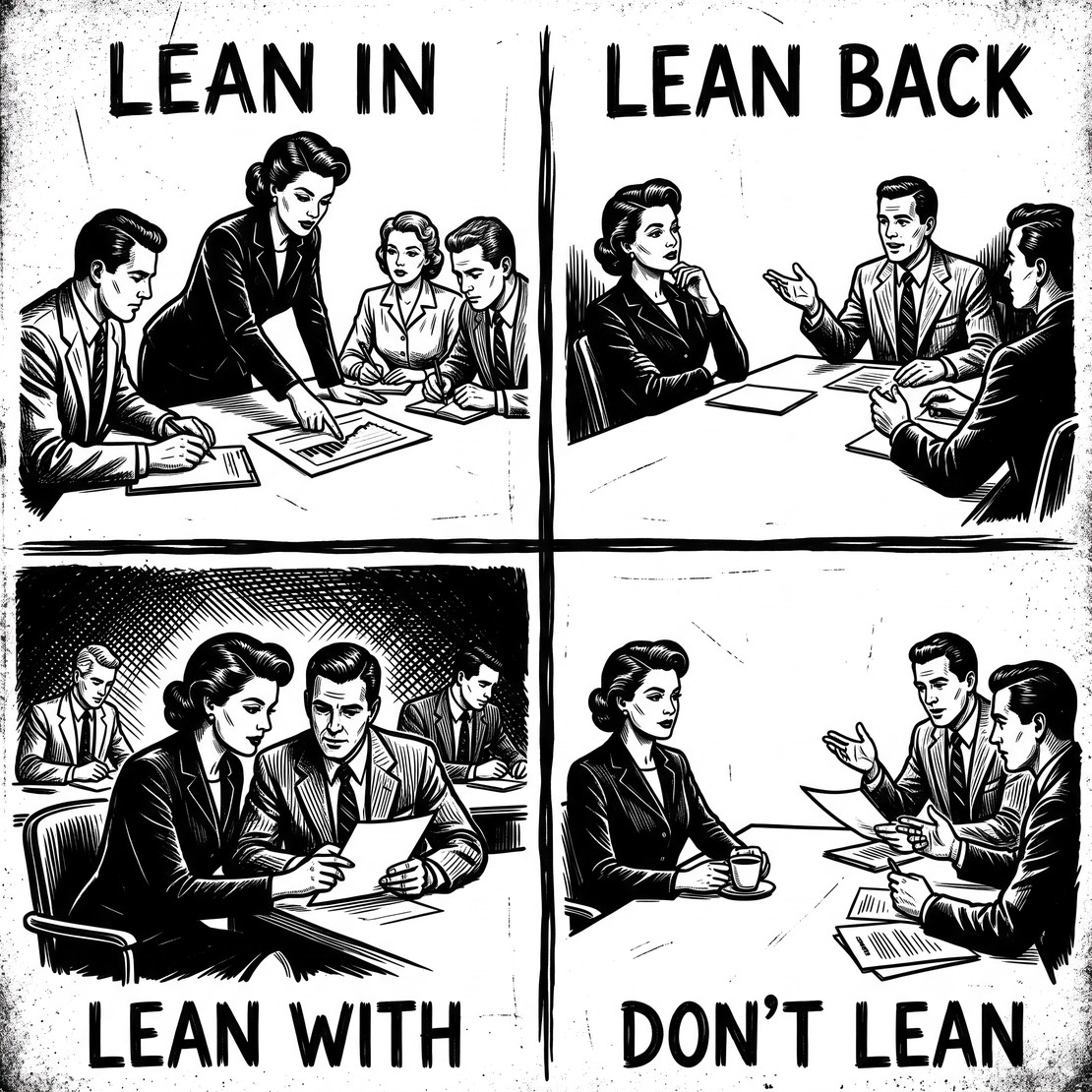
I keep coming back to an idea from David Noble and Carol Kauffman’s “The Power of Options” (opens in a new tab) , published on pages 108–115 of the January–February 2023 issue of Harvard Business Review. They call the choices available to a leader the four stances: Lean In, Lean Back, Lean With and Don’t Lean.
The point is to have options. These are not fixed leadership styles or steps in a hierarchy. One stance is not more mature than another, and the priority in front of you does not automatically tell you which one to use. The priority tells you what result matters. The stance is how you try to reach it effectively, with less unnecessary friction and a sensible use of time, given what is happening with the people involved.
Four ways to show up
Lean In is active leadership: deciding, directing, guiding, challenging or confronting. Use it when the team needs clarity, a decision, a boundary or a way out of a circular discussion. It can create focus quickly. It can also shut down useful input if you use more force than the situation needs.
For example: A project has no clear owner and the deadline is close. You clarify the decision, assign responsibility and make the next step clear.
In short: Lean In when the group needs direction to move forward.
Lean Back is an analytical stance. Observe, ask questions, gather information and make room to think before deciding. It helps when you do not yet understand the problem or the impact of a choice. Stepping back does not mean letting go of the result; it means being deliberate about what you need to know.
For example: A proposed plan sounds convincing, but it depends on assumptions you have not checked. You ask questions and gather the missing information before committing the team.
In short: Lean Back when you need a clearer view before you act.
Lean With is collaborative. Connect, listen, encourage and coach. Use it when people need support, when trust matters, or when understanding different perspectives will help the work move forward. Care is not the same as avoiding a hard conversation. It can help you have one with more context.
For example: A teammate becomes quiet after responsibilities change. You ask how they see the change and listen before jumping in with advice.
In short: Lean With when progress depends on understanding and working alongside people.
Don’t Lean is a deliberate pause. If you are reacting too quickly, or your intervention would close down someone else’s thinking, get still for a moment and let another response emerge. The pause is not an escape from responsibility; it gives you space to choose what to do next.
For example: Someone raises a concern and your first reaction is to defend the decision. Pause, let them finish, and respond once you can take in what they are saying.
In short: Don’t Lean when a pause will help more than an immediate response.
The stance can change when the situation changes
A conflict over accountability
I saw this in a serious conflict between Data Engineering and Software Engineering over a source of truth migration. Accountability and boundaries were being passed back and forth: the teams disagreed about who owned the outcome, and the planning, requirements and coordination were landing unevenly. I asked for the specific pain points behind the feeling that the other team was not owning the outcome, including whether one team was compensating for the other. The debate was no longer helping us find the truth or deliver for the client, so I separated the immediate delivery need from the deeper disagreement about how the teams should own the work. I brought us back to the customer and, in effect, said:
“The customer is paying for the outcome, not our collaboration or our project plan.”
Collaboration is not the obstacle to the outcome; damaged relationships are.
Subsequently, I asked the four managers closest to the engineers to drop other work and prepare a delivery plan together by 5 p.m. Another leader and I would review it and make any decision needed to get the work done. That was Lean In: naming the accountability gap, setting a concrete next step and taking responsibility for the decision. The deadline timeboxed their effort, gave the urgency a boundary and stopped the discussion from circling. I chose that deliberately.
The follow-up conversations were different. In one-to-ones, people had more room to lower the tension and explain their perspective. I could listen and understand before deciding how to move forward. I kept the why, the what and the deadline clear, while leaving the team room to decide how to get there. I stepped into the how only when it was needed. That meant moving towards Lean Back and Lean With without losing the result we were trying to reach. After that, the work started to move more smoothly.
An urgent AI resourcing decision
The same idea mattered when a very late request came in for people to join an internal AI initiative. We had only a two-hour window to nominate people, with no time or opportunity to speak directly with those who might be affected before making the recommendation. The work was framed as alongside existing responsibilities, but it could take a substantial amount of time and affect projects already in flight.
We needed to give the initiative the people it needed to succeed, limit disruption to current work and choose someone who could handle ambiguity and would value the visibility.
I timeboxed a consultation with the engineering managers so we could hear the concerns and still make a recommendation on time. I looked first at how people handled ambiguity, then at what I knew of their work, and then at whether they had expressed interest. I made the nomination after that consultation; my manager held the formal final assignment decision.
There was Lean Back in hearing the managers and weighing the trade-offs, Lean With in taking seriously how the move might affect people, and Lean In in setting a deadline and making the recommendation. The urgency shaped the time available. It did not mean that the only sensible response was to tell someone to move and treat their capacity as interchangeable. The decision also created a responsibility to follow up with the people affected. Those conversations had started, and I still needed to understand the impact; the nomination itself was not proof that the change had worked well for them.
Emotional intelligence runs through the choices
HBR’s model already includes care and connection in Lean With, and space in Don’t Lean. The lens I want to add is to use emotional intelligence across all four stances: notice people’s reactions and expectations, consider what they may not be saying, and think about how your response is likely to land.
That does not mean guessing what someone feels. It means paying attention, asking, and checking your assumptions. If I give direction, does it create clarity or make it harder to disagree? If I step back, does it feel like trust or like abandonment? If I pause, does it give people room or leave them unsure about what happens next? The answer may change from one person or situation to another. Follow up and learn from the impact.
This connects to an earlier article of mine, Calibrated Autonomy (opens in a new tab) . That article asks how much autonomy someone can exercise in a particular skill and situation. The stances ask a different question: how should I show up as a leader right now? In the example between Data Engineering and Software Engineering, I could be clear about the outcome while giving the teams room to decide how to deliver it. The two ideas work together, but they answer different questions.
I do not walk into every meeting naming the stances in my head. The framework has become part of how I think, and it gives me language afterwards to explain what I did and why. If you are new to it, try naming your stance deliberately. Ask yourself: What result matters? What are people showing me? Is my response helping? What else could I try? What should I follow up on?
Remember
- Lean In when the group needs direction.
- Lean Back when you need more information.
- Lean With when progress depends on understanding.
- Don’t Lean when the moment needs a pause.
You do not need one style for every situation. You need enough options to choose well, and the flexibility to change when the moment calls for it.
